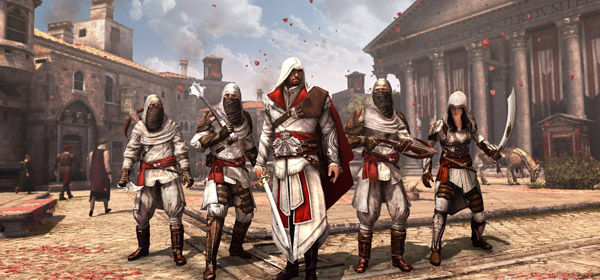
So, after an inexcusable 5 month delay, the PC version of Assassins Creed: Brotherhood finally arrived in March, and I’ve sunk a huge amount of time into it over these past few weeks, yet I haven’t even touched the multiplayer component. I have heard good things, but simply not had a chance to try it out yet, so for this review I will be focusing entirely on my singleplayer experience. Continuing where AC2 left off, Brotherhood expands the story of Ezio and Desmond in the most complete package in the franchise’s lifespan so far.
Brotherhood picks up right where Assassins Creed 2 left off. While Desmond and co. are running for their lives from the Templars in the future, Ezio is still in the Vatican. After fighting the Pope and seeing the crazy vision of some ancient goddess-type, he is left understandably confused and unsure what to do next. You start off in that vault, and must quickly escape. After a glimpse of Rome you end up back at the villa-town, which is the setting for a short, linear introduction sequence involving cannons and a small invasion army. It’s not long before the game opens up properly and you find yourself within the city of Rome itself, ready to explore.
As in the first two games, you’re limited to certain areas of the city which gradually open up the further you progress. This is to simulate Ezio’s real life and keep Desmond synchronised as he delves deeper into his ancestral memories. The basic structure of the previous Assassins Creed game is used once again in Brotherhood – you spend the majority of time nimbly free-running across a huge city and the surrounding countryside, clambering up buildings and murdering guards. You begin with a limited set of abilities and weapons, but this time there are a vast number of ways to progress your character. There’s just so much to do, I found myself easily distracted and wandering off to do my own thing rather then focusing on the main story missions. The regulars are still here, such as scalable viewpoint towers and assassination contracts (delivered via carrier pigeons), but these are overshadowed by some of the newer additions.
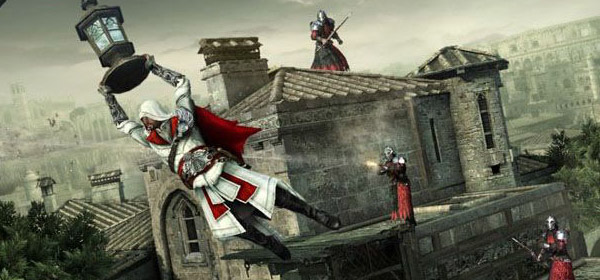
Throughout Rome, the army of Borgia are a constant presence and threat, and Ezio quickly realises he should dwindle their numbers if he is to help the Roman people. Scattered across the map are Borgia towers which must be burnt to the ground. Tackling these involve assassinating the officer in charge of it as silently as possible to avoid alerting his guards, before ascending the tower itself to set it alight. It’s gloriously satisfying, and every time you destroy one, you lower the Borgian influence in the city, which opens up more things to do. Each tower has an area of influence, and once it’s gone, the entire zone is ready to be liberated so you can earn more money.
Renovating shops is the primary source of income in the game, and I found it to be a rather addictive process. With each establishment you renovate, a small figure is added to your regular income – which gets deposited every 20 minutes to any bank in the game. So, the more you renovate, the more you earn. You can also renovate tunnels, which allow quicktravel across the map, numerous famous landmarks throughout the city such as the Pantheon and the Coliseum, as well as a series of broken aqueducts, all of which adds to your income. With your money you can buy weapons, ammo and armour, as well as medical supplies and art for your secret hideout. It’s all very distracting (in a good way) and I was compelled to renovate as much of Rome as possible in order to reap the rewards.
Speaking of rewards, early on in the game’s story you are introduced to a cult known as the Followers of Romulas, who happen to be in possession of a rather fancy bit of armour. Tucked away in some underground tunnels, the armour rests tantalisingly behind a secure cage, and the only way to open it is with 6 special keys. You get these by infiltrating all of the cultists secret lairs throughout the map, and navigating the intricately designed obstacle courses within. They offer a mix of cleverly designed platforming with spouts of combat, and all of them show off the designers talent for environmental architecture.
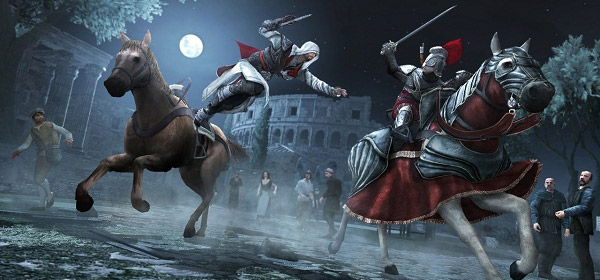
As if this wasn’t enough, Leonardo da Vinci returns to provide you with one other reason to avoid the main story. This time, he’s been hired by the Borgians, against his will, to build some advanced weapons of war, and he needs Ezio to destroy them. I won’t explain any specific details, but let me insist that you take the time to check these brilliant assignments out. They all include some of the best aspects of gameplay found throughout the game, and require you to use Ezio’s superior stealth, climbing and combat skills in equal measure, and all of them feature their own unique set-piece conclusions.
The eccentric artist isn’t the only character you’ll meet – several of Ezio’s allies return from the previous game show up again here and help him to take control of Rome. It’s the main aspect that makes these sequels feel so much different to their predecessor. Altair was a true lone wolf entwined in a much more lonely, atmospheric adventure. When compared to the sequels, its hard to wonder if Ubisoft chose to take the series in the best direction, as a part of me does miss the tense, tactical assassinations from the first game. There was something truly nerve-wracking about making a run for it after a successful kill, the alarm bell ringing in the distance as the entire city turns its attention towards you, and theres virtually no equivalent of those moments to be found in Brotherhood. By contrast, Ezio is a lovable ladies-man on a quest to control an entire city with his friends. Ubisoft have gone completely in a new direction to their first game, and now by introducing the titular ‘brotherhood’ gameplay mechanic, Altair feels even further away. Fortunately, it works extremely well.
By recruiting fellow assassins you build up a team of behind-the-scenes killers, ready to jump into any tough situation you find yourself in. They even gain experience as you play and become stronger, unlocking better armour and new weapons. With the tap of a button, you can call for aid and a small group of your assassins will pounce from the shadows to take out nearby guards. It works best when you are outnumbered by a large group of soldiers and want some backup, but I found it pretty amusing to call for my assassins on individual guards just to see the brutal death animations. You’ll want to be cautious mind, because if an assassin dies, they will be dead forever, and you’ll have to recruit a new one, thus starting the XP buildup process from scratch. There is also a simple minigame which lets you send your recruits off on assignments throughout the world to gain more XP and give you some cash and treasures.
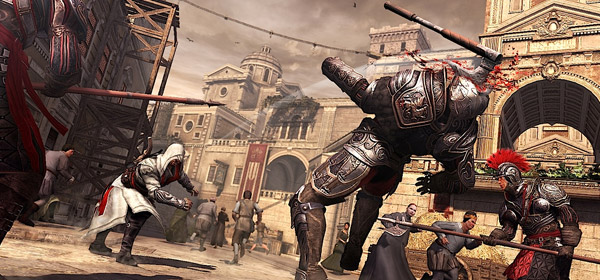
As you can probably tell, Botherhood is a feature-packed game, with the main story being by far the least interesting aspect for me at least. I literally spent hours completing every possible optional mission I could because they were just so much fun. Considering the game was developed in just one year after Assassins Creed 2, I am amazed at how much they managed to cram in, and the game is almost completely bug free. Rome is a wonderful environment to explore, with every building full of minute attention to detail. I recognised many of the landmarks and the artists involved took great care to turn the likes of the Coliseum into fun-filled obstacle courses any gamer worth his while should truly appreciate. Desmond is still there too, but his role is again reduced to a few key moments, rather than constantly interrupting the flow of play. All of the moments with him are a pleasant change of pace and scenery, but to go into any detail would certainly spoil some of the game’s surprises.
To top it all off, Ubisoft scrapped their terrible always-online DRM system. There’s no reason you shouldn’t play this game now. It was a long and almost unforgiving delay (with the exception of some free DLC and sharper graphics, this is identical to the game which came out in November last year for the consoles) – but the PC version of Assassins Creed Brotherhood was well worth the wait, and is one of the best games this year.