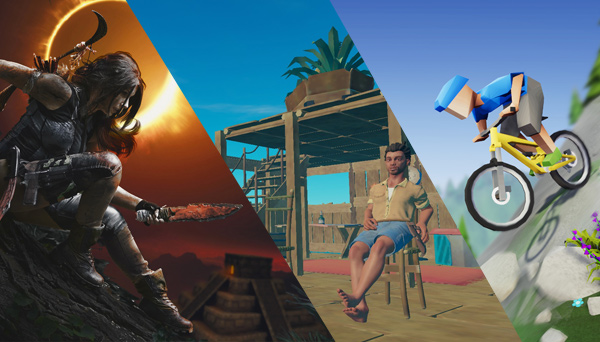
Currently Playing – Shadow of the Tomb Raider, Raft, Lonely Mountains Downhill
By Matt Clarke
October 7, 2020
I’ve been pretty absent from PC gaming for some time, since moving to Canada in early 2017, because I haven’t had a proper computer to play games on. That has recently changed, since I got myself set up with a new gaming rig that can handle pretty much anything that’s out at the moment. I immediately downloaded about 600gb of games, eager to catch up on the last few years of entertainment.
Raft
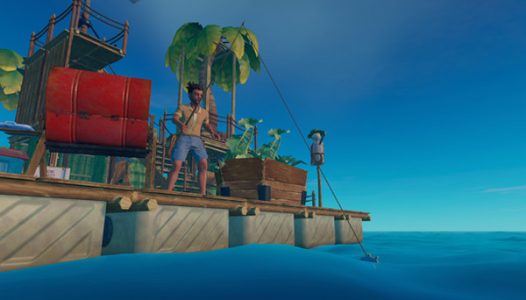
Raft is about being lost at sea and building a raft in order to survive. You can play it with friends, and I have been doing exactly that this week; me here in Canada, my friend Adam back in England, both of us lost at sea with a hungry man-eating shark eagerly circling our makeshift floating home. This is one of those early access games you may have seen which is constantly getting updated and tweaked as development continues but it’s a fine example of a very playable and immersive experience even in this unfinished state.
The game starts and you find yourself standing precariously on a floating platform in the middle of the ocean. There’s nothing in view except a flat expanse of sea water, and all you have in your hand is a plastic hook. The wind begins to gently push you in one direction, and before long, bits of humanity’s garbage begins to float towards you. Plastic bottles, old planks of wood, and the occasional big wooden barrel. All of these things can be reeled in with your hook and collected, which you can then use to begin crafting bits to add to your platform. And you’ll want to do so, because soon enough a great white shark finds you and while he mostly patrols the water giving you very little incentive to ever leave your boat, he sometimes grows impatient and will come along and bite off a chunk of your floating salvation.
I am scared of the ocean in real life, so it’s peculiar that I am enjoying Raft so much, because it makes a terrifying scenario somehow appealing. Adam and I have put in about 20 hours so far, and have discovered many little islands, shipwrecks, and exotic tropical paradises inhabited with animals. The game feels really well paced, giving you a regular stream of incentives to continue improving your raft, items and weapons to defend yourself, new recipes to cook, as well as navigational tools to help you find salvation. It’s really immersive, and being lost at sea has never appealed to me more than this.
Shadow of the Tomb Raider
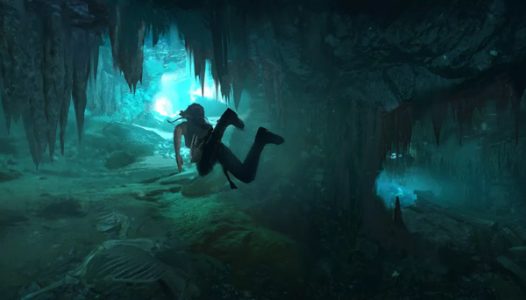
I recently finished Lara Croft’s latest romp, and its probably the best Tomb Raider game made to date. The tombs themselves are stunningly beautiful realisations of a creative vision that started many years ago in the Playstation era. Back then, a tomb was a few muddy brown walls and some infuriatingly difficult water sections. Finally, the technology has caught up to the point of being able to present these as real, feasible places, even if they still all feature convenient scuffs and marks to show you where you can and can’t climb. The locations are some of the finest you’ll see in any videogame. You’ll discover ancient structures nestled deep in the jungles of Peru, swim through majestic underwater caverns teeming with fish, and even explore a sprawling hidden city, a bustling hub town of indigenous tribespeople that by itself takes up about a third of the entire game. Lara herself has never looked better, animated and rendered with cutting edge visual design, a far cry from the pixelated pointy mess from the original games. Crystal Dynamics have made a fantastic trilogy with this iteration of Lara Croft, and in Shadow she finally gets to finish her arc, which is for the most part sincere and well-written. I thoroughly enjoyed my time with this game.
Lonely Mountains Downhill
I’ve got access to Xbox Live’s subscription service on the PC, which includes a slew of games that you can download and play for as long as you maintain the subscription. I downloaded a whole heap of games to try, including Lonely Mountains Downhill and Descenders, two mountain biking games. These games approach the sport very differently, and I reckon the stylised, thoughtful approach of Lonely Mountains results in a better game experience, but it depends what you’re after.
Descenders is all about simulating the pro-lifestyle of a sponsored rider. You compete in time-trial style races, which feature varied objectives and race styles. There’s a serious sense of speed to some of the runs, and it’s quite a thrill to get down a track at hair-raising speeds without crashing. The controls are quite intuitive, reminding me a little of the old Tony Hawks skateboarding games, where you can perform various tricks by pulling the analog stick in different directions while in midair. It’s pretty slick, and captures the style and attitudes of the mountain biking scene. It’s also fully multiplayer, featuring a hub where players can ride around with each other and challenge one another to races and of course features a fully implemented leaderboard system. All the tracks are procedurally generated too, which is quite cool.
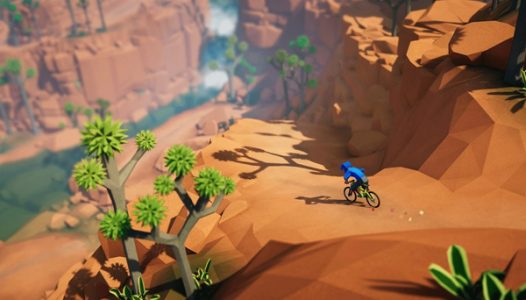
Lonely Mountains Downhill is a much more relaxed experience. The first thing you’ll notice after the charming, blocky visual aesthetic is the minimalistic approach to sound design. The wind blows through the trees, birds tweet and rivers bubble and gurgle. That’s it. There’s no music at all and the game feels very pleasant because of it. It’s just you and the mountain, as the game’s title promises. The camera is fixed in place, meaning you are not usually positioned behind the biker at all, rather you have a pulled-back view of the slope you are traversing and must react to obstacles as you see them, making it a little bit fiddly to begin with, but after a single run I immediately saw the appeal of designing it this way. You can really appreciate the carefully designed tracks this way, and there are many shortcuts and nooks to discover. Trying to beat your previous time is elegant as each track is split into sections with checkpoints, so you can see how well you are doing on your current run as you make your way down.
There’s 4 different mountains, each with at least 4 different tracks, sometimes they overlap one another, and sometimes they take place on opposite ends of the mountain only meeting up at the finish line. This makes each one feel like a small part of a larger world, and helps to emphasise that isolated, almost melancholic feel of riding down a mountain by yourself. I’m finding this game really nice to play after a long day at work. It’s the perfect blend of relaxing and challenging and is really just a joy to play.
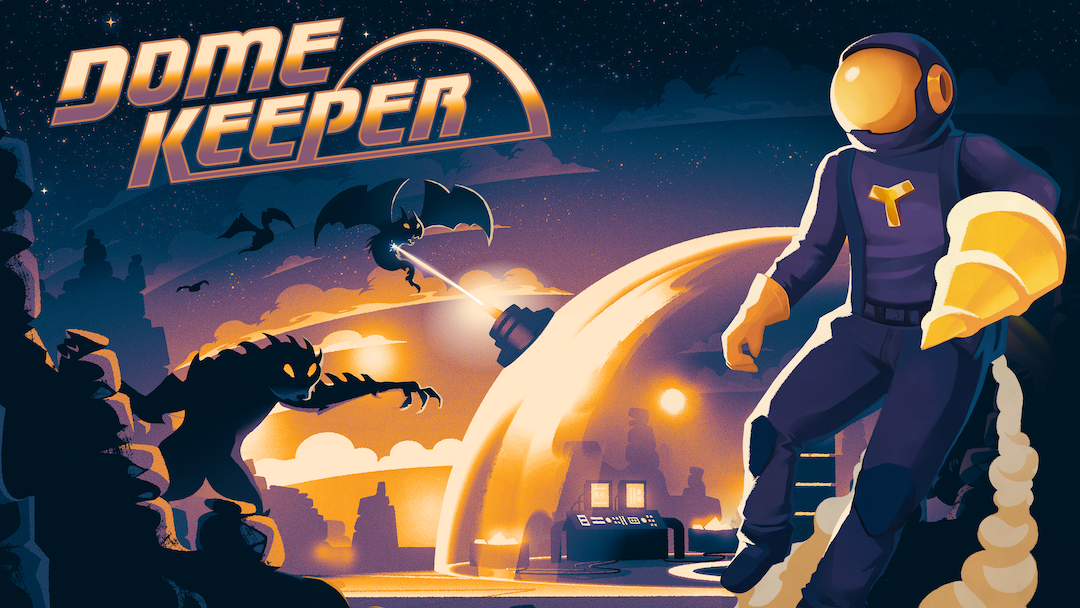
Dome Keeper is an excellent little spin on the tower defense game, in which you play the role of a jetpacking miner defending his base from swarms of aliens, whilst searching for a hidden relic buried somewhere beneath him. And now, with this huge free update, you can play it with friends.
I want to talk about Cloudpunk, a game where you get to be a flying-car delivery driver in a futuristic cyberpunk city. Its world is an incredible achievement of environmental design, and while the gameplay itself may be basic, the city of Nivalis is a thing of beauty to behold. Nivalis is built out of hundreds of hand-modelled cuboid buildings; there’s nothing procedural about it. Apparently it took 3 years for the devs to design the city, and it really shows.
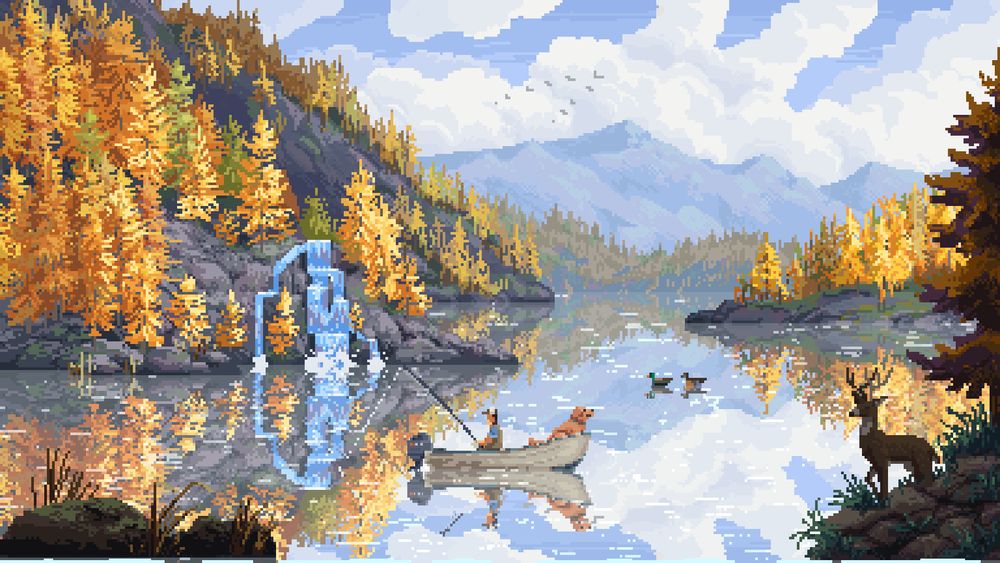
I do love me some quality pixel art, and it doesn’t get much better than this. Cast n Chill is a cozy side-scrolling fishing game by small indie dev team Wombat Brawler, with absolutely gorgeous visuals. It’s simple to play, and you you can dip in and out of it at your leisure, making it a fine addition to our collection of coffee break games.
Here’s another game that was introduced to me by my uncle Dave (who to this day, does the best impression of the monk from the first game out of anyone I know – “WOLOLOOOH!”) Anyway, I learned more history from playing Age of Empires 2 than I ever did in school. I experienced the brutal horde of Attila the Hun as he ravaged old Europe. I followed the rise of El Cid, and helped Ghengis Khan flood across Asia. I can’t remember much else actually, because my mind always turns to making a plague of Persian elephants to send at my enemies, crushing all of their puny houses and stamping their cities into the dust, mwhahaha! Ah man, it’s an absolute classic game, the first strategy game I ever played and thanks to the recent HD remake, is still a lot of fun even 18 years later.
VVVVVV is one of the only 2D platform games that I have completed from start to finish, which makes it special to me. I became obsessed with Veni Vidi Vici, an entirely optional sequence of deadly traps that teases you with a collectible orb right in the very first room, which is blocked off by a tiny box. You can’t jump in the traditional way as most other platformer’s, so the only way to overcome the box is by leaping up through the ridiculously cruel chambers above, navigating your way to the top…and then back down again.
It may look clunky as hell thanks to the original Unreal engine, but Deus Ex was a pioneer in videogames because it gave the player so many choices to make. It resulted in one of the deepest gaming experiences of the time, because it went to great effort to show the consequences of those choices. The story was spread across many ‘hub’ levels, giving you total freedom to approach your objectives whichever way you wanted, aided by an RPG style upgrade tree that you invested in as you played. Wanna finish it without killing a single soul? That is entirely possible. Prefer to tool up with a rocket launcher and just murder your way to the end? Nothing could stop you. Your NPC allies would respond differently back in the Unatco base, depending on what you did out in the field. This level of responsiveness was unparalleled for a long time, to the point that even if you walked into the ladies toilets, your boss would scold you for it during the mission debrief later on. It was many little moments like that which made the game so memorable for me.